What Crops Are Grown in Indiana (and What That Tells You About Your Parcel)
A plain-language answer to what crops are grown in Indiana (corn, soybeans, wheat, hay, and pockets of melons and mint), tied to why soil and drainage drive the pattern, with concrete next steps for post-harvest soil health and cash-rent benchmarking on a reader's own parcel.
What crops are grown in Indiana?
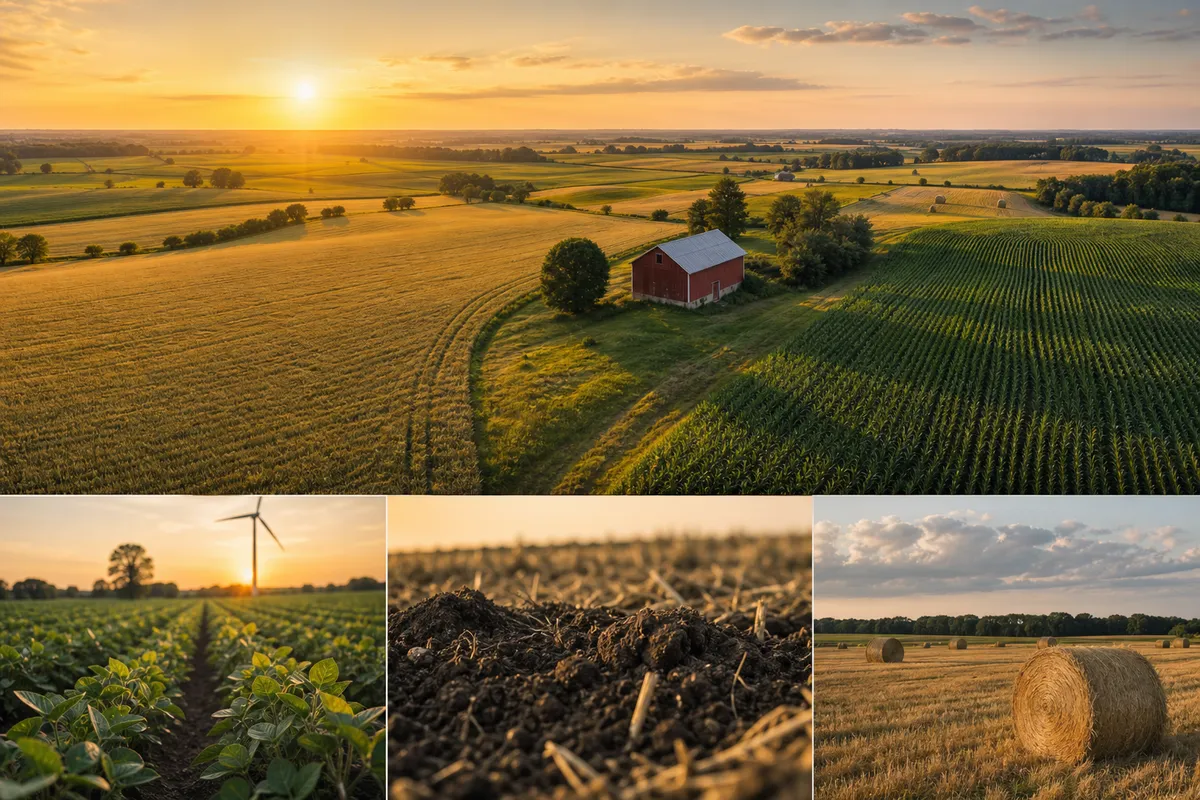
Corn and soybeans, mostly. Together they cover the large majority of Indiana's cultivated acreage, planted in rotation on the same fields year after year, according to USDA NASS county-level crop data. Winter wheat shows up as a smaller third crop, often double-cropped with soybeans in the southern part of the state. Hay and forage acreage clusters around livestock operations. And then there are the pockets that don't fit the pattern at all: melons and cantaloupes in the sandy soils of Knox and Gibson counties down along the Wabash, and Indiana's small but real mint industry concentrated up in the northern counties where muck soils hold moisture differently than the clay loam farther south.
If you searched that question because you're staring at a specific piece of ground, the statewide answer is only the starting point. The real question is why your county grows what it grows, and whether your parcel is actually suited to the same rotation as the farm next door.
Why does the crop mix change by county?
It's not tradition and it's not what the neighbors have always done. It's soil and drainage, full stop.
Corn and soybeans dominate central and east-central Indiana because that ground sits on some of the highest-productivity soils in the state: deep, well-drained loams that USDA NRCS rates highly for row-crop yield potential. Move southwest into the hillier, more variable ground of counties like Brown or Martin, and you'll see more pasture and hay, because the slope and soil type make row-cropping harder to justify economically even if it's technically possible. The mint and melon pockets exist because sandy, well-drained soils and muck ground handle those crops in ways that heavier clay soils simply don't.
None of this is a mystery or a black box. USDA NRCS has been mapping soil type, drainage class, and productivity rating parcel by parcel for decades, and that data is public. The pattern you see driving across Indiana in September, corn one county and pasture the next, is soil data made visible.
What does this mean for your specific parcel?
Here's where the statewide picture stops being useful on its own. Your parcel might sit in a county where corn and soybeans dominate, and still have a soil profile that performs below the county average, or above it. Averages hide that. A county-level cash rent figure or crop mix number is built from every parcel in that county, the excellent ground and the mediocre ground both, blended into one number that describes no actual field.
If you want to know what your ground can really support, check crop history and suitability for a specific address rather than assuming your parcel matches the county norm. That's true whether you're the owner who's farmed it for twenty years, an heir who just inherited ground you've never walked, or a buyer doing due diligence before closing. If you're in that last group, it's also worth asking for the yield history before you buy: a seller's word about what a field "usually does" is not the same as USDA data showing what it actually did.
What to do with this information right after harvest
Three moves make sense once harvest wraps and you know what came off your fields this year.
Check post-harvest soil health. Yield tells you what happened this season. It doesn't tell you what your soil has left to give next season. A parcel-level soil rating from USDA NRCS shows you the drainage class and productivity potential of your specific ground, which matters more than last year's yield number when you're deciding whether to keep the same rotation or make a change.
Benchmark your cash rent against the county, not against a guess. USDA NASS publishes county cash rent averages every year, and if you're negotiating a lease renewal this fall, that's the number to start from. But remember: it's an average across every parcel in the county, strong ground and weak ground both. If your soil rating sits well above the county average, an average-based rent is underpaying you. If it sits below, an average-based ask might get you laughed out of the negotiation. Our guide on why your county's average cash rent might not match your offer walks through how a single wet or dry year skews that average further.
Ask whether the current crop mix is actually the best use of the ground. A field that's grown corn and soybeans for thirty years isn't necessarily the field's best option, it might just be the option nobody's re-examined. Comparing your parcel's real soil rating against alternative uses, including how it stacks up for a lease versus continued farming, is worth doing before you assume the status quo is the ceiling.
Where the numbers actually come from
Every claim above traces back to two of our six federal sources: USDA NRCS for soil type, drainage, and productivity ratings, and USDA NASS for crop history and cash rent survey data. Neither is a proprietary score somebody built in a spreadsheet and won't show you the formula for. Both are public records, updated on a regular cycle, and both apply to your specific parcel, not just to Indiana as a whole.
That distinction matters more than it sounds like it should. A lot of the numbers floating around in casual land conversation, whether it's what a neighbor says their cash rent is or what a broker claims your soil is worth, don't cite anything. Ours do, every time, because a number without a source is just an opinion wearing a decimal point.
Check your own parcel before you decide anything
The statewide crop map is real and it's useful context. But it's not your field. If you own ground in Indiana and want to see how it actually rates, not the county average, run your parcel through Agriterra Scout's free analysis and get a plain-language read on soil productivity, crop suitability, and cash rent benchmarking pulled straight from USDA NRCS and USDA NASS. It takes under a minute, and it's the difference between deciding based on your parcel and deciding based on your county's average parcel, which is a very different piece of ground.
Frequently asked
What is the main crop grown in Indiana?
Corn and soybeans together cover the overwhelming majority of Indiana's cropland, usually rotated year to year on the same fields. Which one leads in a given year depends on commodity prices and the rotation schedule, not a permanent state preference. USDA NASS tracks the year-by-year split by county, so the exact numbers move, but the corn-soybean rotation is the backbone of Indiana row-crop farming statewide.
How do I find out what crops my land can actually grow?
Start with a USDA NRCS soil survey for your parcel, which rates drainage, texture, and productivity class for the exact ground you own, not the county average. Agriterra Scout pulls that NRCS data plus USDA NASS crop history into a plain-language report for a specific address, so you're checking your parcel instead of guessing from a statewide map.
Where can I check cash rent by county in Indiana?
USDA NASS publishes county-level cash rent survey data every year, broken out by land type (irrigated cropland, non-irrigated cropland, and pasture). That's the source of record, but it's a county average, not your parcel's number. Benchmarking your specific ground against it is the next step before you sign or renew a lease.
Go deeper: the reference guides
- What farmland produces Yields and income per acre, from public data.
- What crops grow in Indiana? Indiana crop acres from USDA NASS.
- What crops grow in Ohio? Ohio crop acres from USDA NASS.
See what your acres could earn
Start with a free parcel read: soil, water, flood, and what the ground could earn farmed, rented, enrolled or leased. When a decision is worth it, the Decision Report is $89 once for one parcel, or 5 a month with Land Scout at $39 a month.
Launch Scout