USDA program eligibility
USDA Program & CRP Eligibility Checker
For landowners and farmers who want to know which USDA conservation and commodity programs (CRP, EQIP, CSP, ACEP-ALE, ARC-CO, PLC) their parcel is a likely candidate for.
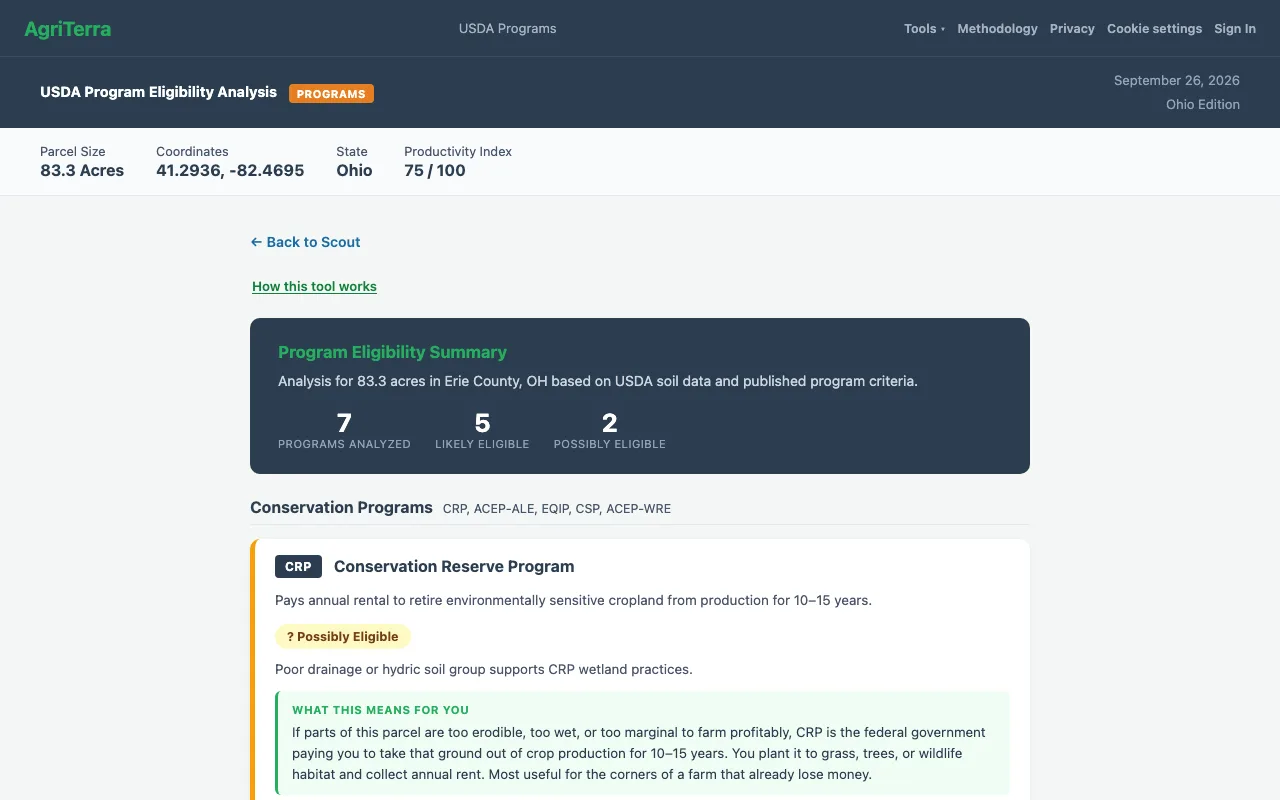
The AgriTerra USDA Program Eligibility Checker is a free tool that screens a parcel against the major USDA programs (CRP, EQIP, CSP, and ACEP-ALE on the conservation side, ARC-CO and PLC on the commodity side) using the parcel’s own NRCS soil data. It is built for landowners and farmers who want a fast, parcel-specific read on which programs to ask about before they call their county FSA or NRCS office.
CRP: Not available now: new CRP enrollment is paused until Congress extends the farm bill (USDA FSA, Sept 25, 2026). How CRP works. The checker still flags the acres the soil data marks as likely eligible.
How the eligibility checker works
- Select your parcel. Search an address or drop a pin; Scout locates the parcel and reads its NRCS soil data: capability class, erodibility, drainage, and current land use.
- The parcel is matched against each program. The tool checks those soil and land-use characteristics against the general criteria for CRP, EQIP, CSP, ACEP-ALE, ARC-CO, and PLC.
- Read the eligibility summary. A summary shows which programs your parcel is a likely candidate for, split into conservation programs and commodity programs, with the reasoning behind each.
- See why. Each program flag points at the soil or land-use trait that drives it (highly erodible acres for CRP, cropland history for ARC-CO/PLC), so the answer is explainable, not a black box.
- Take it to USDA. Email the results to yourself and bring them to your county FSA or NRCS office, which makes the actual determination and handles enrollment.
What the eligibility read is based on
The checker’s judgment comes from your parcel’s real soils, not a questionnaire:
- Soil data: USDA NRCS (SSURGO) capability class, erodibility, and drainage for the parcel, the same characteristics USDA weighs for conservation eligibility.
- Land use: current and historical land use from USDA CropScape, which matters for programs that hinge on cropping history like ARC-CO and PLC.
- Program rules: the general, published criteria for CRP, EQIP, CSP, ACEP-ALE, ARC-CO, and PLC, applied as a screen rather than a final ruling.
Be clear-eyed about what this is: a screening estimate. USDA program rules carry state signup periods, county rental rates, ranking points, and practice-specific requirements that only your local office can apply. What the checker does well is stop you from overlooking a program your soils appear well matched to, or driving to the FSA office for one your soils rule out. A parcel with highly-erodible acres can flag as a CRP candidate on those acres, while a well-drained, actively-cropped field can flag for ARC-CO/PLC commodity coverage instead.
A worked example
A mixed Ohio crop parcel. Most of it is prime, well-drained cropland, but a creek cuts through one corner, leaving acres that flood and erode. The owner has always farmed the whole thing, losing money on that corner most years.
The eligibility checker reads the corner's highly-erodible, poorly-drained soils and flags those acres as a likely CRP candidate, while flagging the productive bulk of the parcel for ARC-CO/PLC commodity coverage. The owner leaves with a specific question for the FSA office: can I put these acres in CRP? That is the difference between a generic article and a parcel-specific screen.
What the screen checks
For CRP specifically, the screen looks at the same traits USDA weighs: your parcel’s soil capability class, erodibility, and drainage from NRCS data, and its cropping history from CropScape. Highly erodible, wet, or marginal acres are the ones that tend to flag as CRP candidates, because those are the acres the program is designed to pay for. The screen does not set your rate; that is your county soil rental rate, decided at enrollment.
If you want the background before you screen a parcel, the plain-language CRP guide covers what the Conservation Reserve Program is, general versus continuous signup, what land qualifies, and how signup through FSA worked. For the dollars, CRP payment rates by state lays out the general and continuous averages and explains why your county rate will differ.
Who it’s for
Landowners with marginal, wet, or erodible acres that might earn more in a conservation program than in production; farmers deciding on commodity-program coverage for cropped ground; and heirs assessing inherited land they don’t yet know well. To weigh a CRP outcome against simply farming or leasing the same acres for solar, carry it into the farm vs. solar vs. CRP calculator.
Frequently asked questions
- Does the eligibility checker cost anything?
- No, checking a parcel against USDA conservation and commodity programs is free and needs no account. It’s a screening read, so you know which programs are worth a call to your county FSA or NRCS office.
- Is this an official USDA enrollment tool?
- No. AgriTerra is independent and not affiliated with USDA. The checker estimates likely eligibility from your parcel’s soil data to point you in the right direction; actual eligibility and enrollment are determined by USDA at your local FSA and NRCS offices.
- Which programs does it cover?
- On the conservation side: CRP (Conservation Reserve Program), EQIP, CSP, and ACEP-ALE. On the commodity side: ARC-CO and PLC. The summary shows which of these your parcel is a likely candidate for and why.
- What is this "CRP"? Is it the same as the gas or medical programs?
- Here CRP means the USDA Conservation Reserve Program: the farm-bill program that pays landowners an annual rental rate to take environmentally sensitive cropland out of production. It is unrelated to utility customer-assistance programs or research programs that share the initials.
- How does it decide if my land is eligible?
- It reads your parcel’s USDA NRCS soil data (capability class, erodibility, drainage, and land use) and matches it against each program’s general criteria. Because it starts from the actual soils under your parcel, it’s a far better first read than a generic explainer.
- Does it work in my state?
- The USDA soil data behind it is national, so you can screen a parcel anywhere. Program rules have state and county nuances that only your local FSA/NRCS office can confirm, which is exactly why the tool frames itself as a starting point.
Related tools
Land-Use Optimizer
Compare every use of your acres, row crops, cash rent, CRP, solar, wind, by modeled return.
farmland use optimizer →Decide
Compare farming, a solar lease, and CRP on 5-year income, capital, reversibility, and risk.
farm vs. solar vs. CRP calculator →Or see all six free farmland tools.
See which programs your parcel screens likely eligible for.
Screen any U.S. parcel free against CRP, EQIP, CSP, ACEP-ALE, ARC-CO, and PLC, from its own soil data.
Free to start. The full Decision Report is $89.