Lease & cash-rent manager
Farm Lease Manager
For landowners and farm managers who want to track every lease payment and check the rent against USDA county benchmarks in one place, not a shoebox and a spreadsheet.
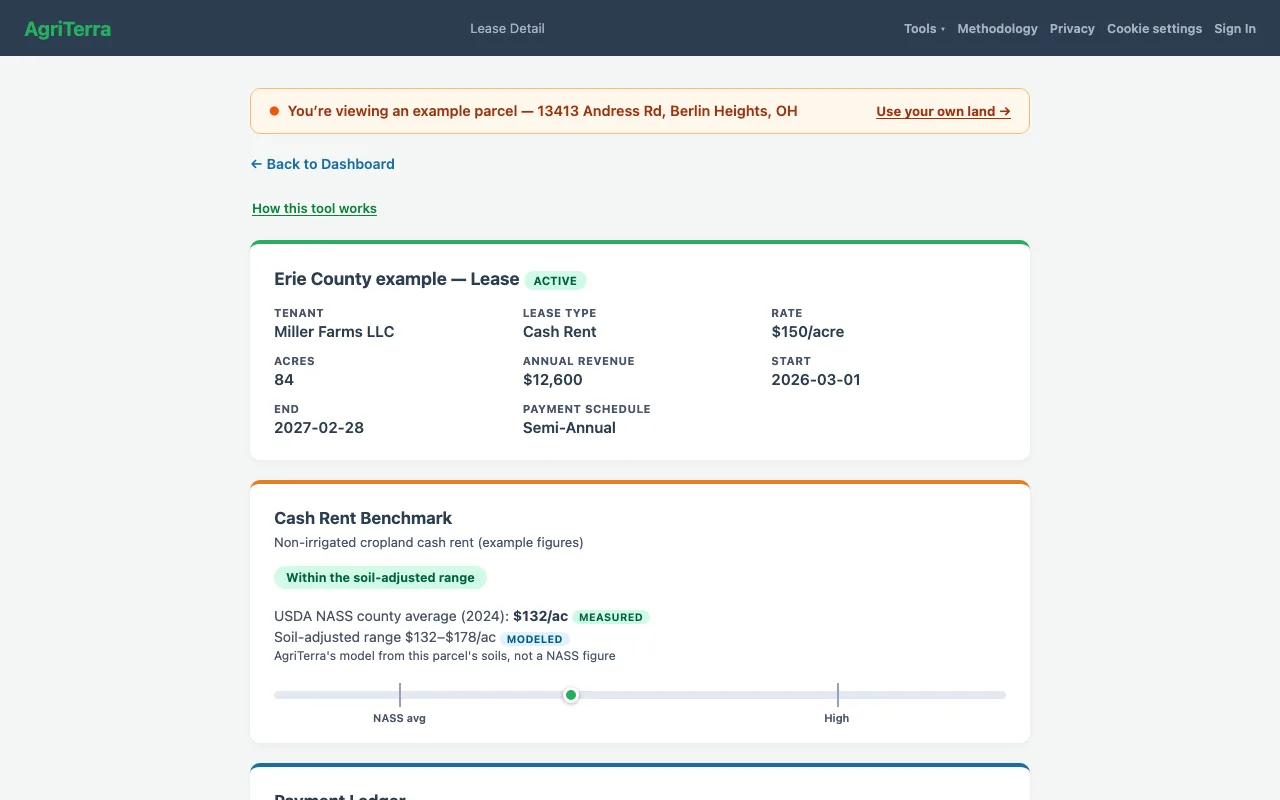
The AgriTerra Lease Manager is free farm-lease software that keeps every farmland lease and its payment history in one ledger, then measures the rent against USDA NASS county cash-rent benchmarks. It is built for landowners and farm managers running several leases who want to know, at a glance, whether each rent sits above or below what comparable ground in the county actually fetches.
How the lease manager works
- Add a lease. Enter the parcel, the term, the rent, and the tenant or landlord. Scout attaches the parcel’s county so the benchmark and any soil or value context line up automatically.
- Log payments to the ledger. Record each rent payment as it comes in. The payment ledger gives you a running record instead of a stack of checks and a memory.
- Read the cash-rent benchmark. For each lease, see the USDA NASS county cash-rent benchmark next to your actual rent, so you immediately know whether you’re under-, at-, or over-market.
- Watch the market trend. A trend view shows which way county rents have moved, which is the context you want before a renewal conversation.
- Optionally contribute anonymously. A clearly-labeled, off-by-default toggle lets you include a lease in anonymous market data, improving the benchmark for everyone without revealing your terms.
What the numbers are based on
The benchmark that makes the lease manager more than a ledger is federal survey data, not a crowd-sourced guess:
- Cash-rent benchmark: USDA NASS county cash-rent survey data, the same figures extension economists cite, shown for the parcel’s county with the source and survey year attached.
- Market trend: the direction of county cash rent across recent NASS survey years, so a benchmark is read as a moving line, not a single point.
- Parcel context: where Scout’s parcel data is live, the lease is tied to real soil and value context from NRCS SSURGO and USDA NASS land values, so you can see why a rent might reasonably sit above or below county average.
A note on honesty: county cash rent is an average across very different fields. Irrigated, high-CSR ground rightly rents above the county line, and rough or wet acres below it. The benchmark tells you where the middle is; the soil context tells you where your specific parcel should sit relative to it. Two quick examples of the read (illustrative): a lease at $150/acre in a county benchmarking near $175 flags as roughly $25/acre under-market (about $4,000 a year on a 160-acre parcel), worth surfacing before a renewal.
A worked example
A landowner with four leases across two Indiana counties. Three were set years ago and renew on a handshake. Loaded into the lease manager, two of the older leases show up well below their county benchmarks, while the newest is right at market. The payment ledger also surfaces that one tenant is habitually a month late, visible now as a pattern instead of a vague sense.
Armed with the benchmark, the trend line, and the soil context showing the under-market parcels are actually above-average ground, the owner walks into renewal season with a number and a source instead of a feeling, and a clear case for bringing two rents up toward the county line.
Who it’s for
Landowners with more than one lease to keep straight, farm managers stewarding ground for absentee owners or an estate, and heirs who’ve just inherited leased farmland and need to understand what it earns. To go deeper on any single parcel behind a lease (soil, value, flood, and market context in one read), open parcel insights.
Frequently asked questions
- Is the lease manager free?
- Yes, tracking leases, logging payments, and checking rent against county benchmarks are free. There’s no per-lease fee and no subscription required to use it.
- Do I need an account to track my leases?
- Tracking leases and payments over time is the one place an account helps, so your ledger persists between visits. Checking a cash-rent benchmark for a county, though, you can do immediately without signing up.
- Where do the cash-rent benchmarks come from?
- From USDA NASS county cash-rent data (the federal survey of what farmland actually rents for), shown as a benchmark for the parcel’s county so you can see whether a given lease sits above or below the county line.
- How current is the rent benchmark?
- NASS publishes county cash rent annually, and the benchmark reflects the latest available survey year, with the source and year shown alongside the number.
- Is my lease data shared with anyone?
- No. Your leases and payments are yours. There is an optional, clearly-labeled toggle to include a lease in anonymous market data (off unless you turn it on), which helps improve the benchmarks without exposing your terms.
- Does it cover leases in my state?
- You can track a lease anywhere, and NASS county cash-rent benchmarks are available across the U.S. farm belt. The parcel lookup that attaches soil and value context is live in Ohio and Indiana first and expanding.
Related tools
Insights
One plain-language read on a parcel’s soil, value, water, flood risk, and market context.
parcel data lookup →Land-Use Optimizer
Compare every use of your acres, row crops, cash rent, CRP, solar, wind, by modeled return.
farmland use optimizer →Or see all six free farmland tools.
Know whether your rent beats the county.
Track your leases and payments free, with USDA county cash-rent benchmarks next to every one, no subscription required.
Free to start. The full Decision Report is $89.